
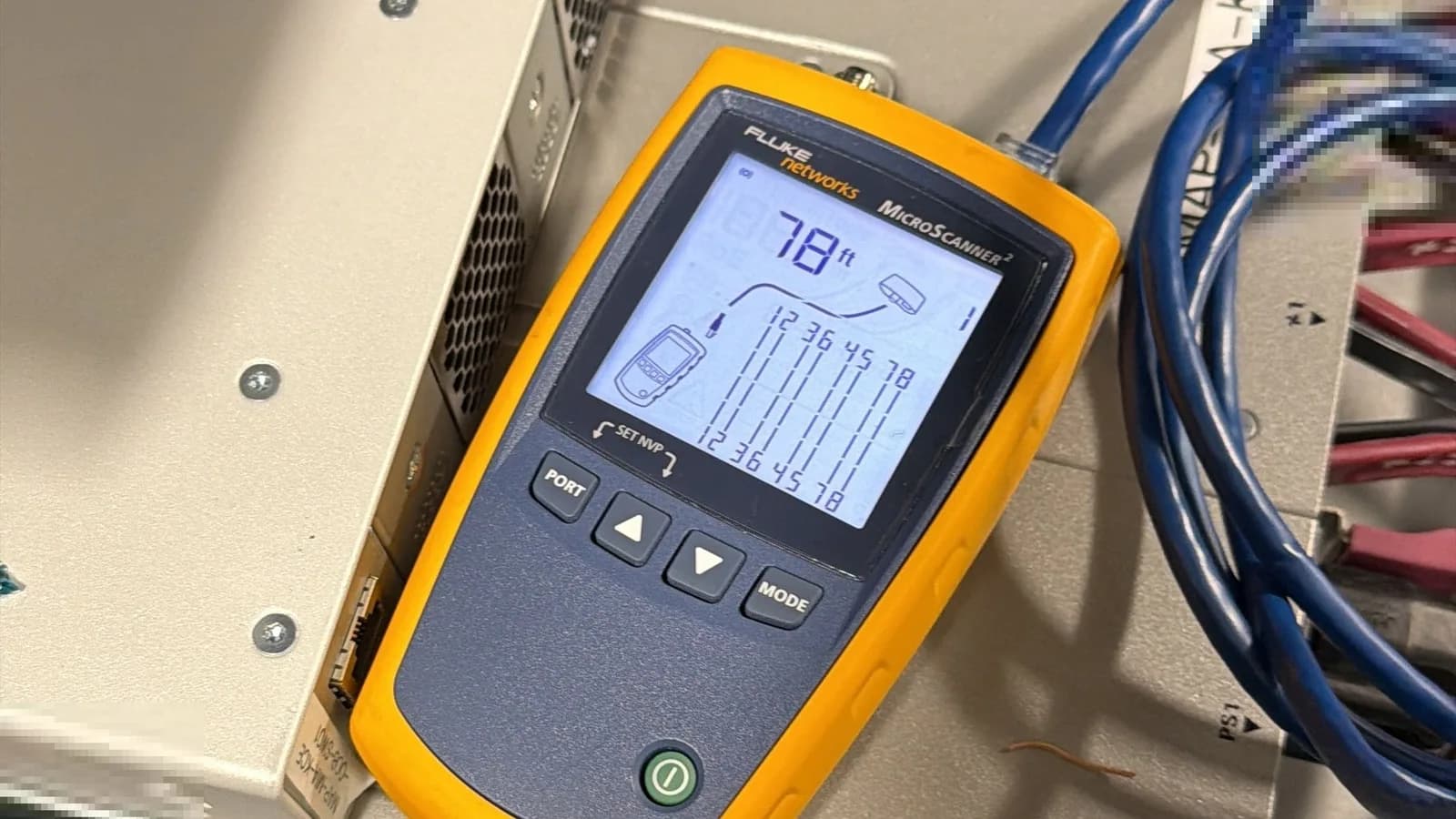
If it isn't certified, you don't know if it'll hold
A cable that passes traffic today isn't the same as a certified cable. Plenty of installs — ours or another contractor's — get handed over tested by eye, without the report proving every link meets standard.
We certify copper and fiber with calibrated Fluke instruments, whether we ran the cable or not. The report stays with you.
What the service covers
Cat6 and Cat6A copper
Link-by-link certification with a Fluke DSX-8000 CableAnalyzer, against TIA-568.
Multimode and single-mode fiber
Insertion loss and length with a Fluke CertiFiber Pro, against TIA-568.3-E.
Independent service
We don't need to have installed the cable ourselves — we certify third-party installs the same as our own.
How we work
- 1
It gets scheduled
We coordinate access and a work window without disrupting your operation.
- 2
It gets measured
Calibrated instrument, link by link. Copper and fiber, our cabling or someone else's.
- 3
It gets documented
A report with loss, length, and margin for every link.
- 4
It gets fixed, if it needs it
If something doesn't pass, we tell you with the exact number. You can fix it, or we can.
Why the instrument matters
Calibrated instrument
The Fluke units we use carry current, traceable calibration. Without that, the result isn't a certification — it's an opinion.
Every link, not a sample
We certify 100% of the points, not a random percentage. If something fails, you know exactly which one and where.
A report that's useful
A PDF with loss, length, and margin for every link — for audits, warranty claims, or the next installer who touches the network.
What if the cabling isn't ours?
That's fine. Certification doesn't depend on who installed it — it depends on the instrument and the standard. We'll tell you exactly which links pass and which don't, no matter who installed them.
Want to talk about your project?
Tell us what you need and an engineer gets back to you.
Request a Technical Assessment